Quick Answer
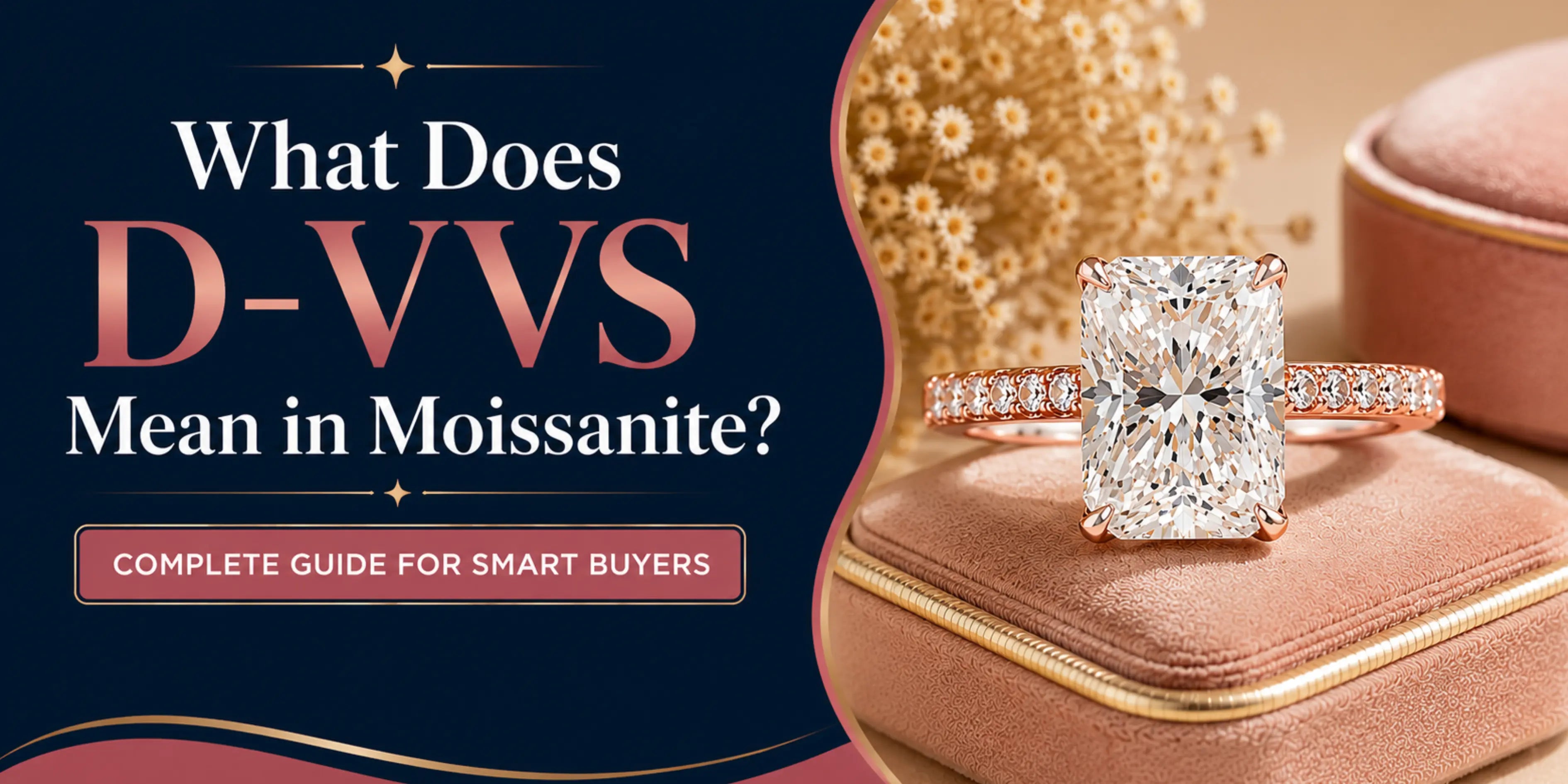
D-VVS is shorthand borrowed from diamond grading. "D" is the highest color grade on the D-to-Z scale, meaning the stone shows no detectable tint, and "VVS" stands for Very, Very Slightly Included, the clarity grade just below flawless, meaning any inclusions are essentially invisible without magnification. Put together, a D-VVS moissanite is graded as close to colorless and clean as the scale goes, and unlike in mined diamonds, that combination doesn't come with a steep price premium.
Key Takeaways
What Does D-VVS Actually Mean?
Every gemstone gets judged on the 4Cs: cut, color, clarity, and carat. "D-VVS" is shorthand that covers two of those four, color and clarity, packed into a single string of letters because that's how the diamond trade has labeled stones for decades, and the moissanite industry adopted the same vocabulary. When you see it stamped on a listing title, it's telling you two separate grades at once, not one combined score.
Split apart, the two halves mean different things. "D" is a color grade, describing how free of tint a stone is. "VVS" is a clarity grade, describing how free of internal or surface characteristics it is. A stone can be D color with average clarity, or top clarity with a warmer color, so it's worth knowing what each letter is actually measuring before you read too much into the combination.
Measures tint
Where the stone sits on a scale from colorless to visibly yellow, gray, or brown. D is the top of that scale.
Measures inclusions
How visible any internal or surface characteristics are under magnification. VVS sits just below flawless.
The "D" Color Grade, Explained
Color grading runs on a letter scale from D to Z, and it deliberately starts at D rather than A, so shoppers never assume a higher grade exists above it. D sits at the very top: a D-graded stone shows no detectable color at all, appearing perfectly colorless face-up. Move down the alphabet and a faint tint gradually creeps in, D through F are generally grouped as "colorless," G through J as "near colorless," and grades continue dropping toward a visibly warm cast by the time you reach the far end of the scale near Z.
Older moissanite had a reputation for a faint gray or greenish cast that gave the stone away next to a diamond, which is part of why some shoppers still assume moissanite can't be truly colorless. Manufacturing improvements have changed that. Today's premium moissanite is produced to land in the colorless D-to-F range as a standard outcome, not as a rare exception, which is a meaningfully different story than what color grading looks like in mined stones.
The "VVS" Clarity Grade, Explained
Clarity grading runs from FL (Flawless) down through IF, VVS1, VVS2, VS1, VS2, SI1, SI2, and finally I1 through I3 at the bottom. VVS stands for Very, Very Slightly Included, the tier directly below internally flawless. At that grade, a trained grader using 10x magnification can just barely locate an inclusion; to the naked eye, the stone reads as completely clean. VVS1 sits marginally above VVS2 based on how easily that inclusion is spotted under the loupe, but both grades are well past the point where anything is visible without equipment.
It's worth separating VVS from "eye-clean," a term you'll also see in moissanite listings. Eye-clean isn't an official grade, it's a practical description meaning no inclusions are visible to the naked eye at normal viewing distance. Most VS-clarity stones are also eye-clean, and some SI1 stones are too. VVS is a statement about what shows up under a jeweler's loupe, not a guarantee that a lower grade would actually look flawed on your hand.
Why Moissanite Borrows Diamond's Grading Language
Moissanite is a different mineral from diamond entirely, silicon carbide rather than pure carbon, first identified in a meteorite fragment by French chemist Henri Moissan in 1893 and produced synthetically for jewelry ever since. The organization that defines the D-to-Z and FL-to-I3 scales, GIA, grades diamonds exclusively. It does not certify moissanite.
Retailers apply that same familiar language to moissanite anyway, because shoppers already know how to read it from diamond shopping, so "D color, VVS1 clarity" communicates instantly without needing a new vocabulary. The trade-off is that moissanite doesn't have one universal, standardized grading authority the way diamonds do. Independent labs, GRA being the one most commonly cited on moissanite certificates, issue grading reports using this same terminology, but rigor can vary somewhat from lab to lab and seller to seller. The letters in a product title are a starting point; the certificate behind them is what actually backs the claim up.
Does D-VVS Cost More in Moissanite?
In mined diamonds, D color and VVS clarity are genuinely rare combinations pulled from the ground, which is exactly why they carry a steep price premium, you're paying for scarcity as much as appearance. Lab-created moissanite starts from a controlled growth process, so producing a consistently colorless, clean crystal is closer to the standard result than a rare stroke of luck.
Practically, that means a shopper can buy a stone graded at the top of both scales without paying the rarity tax built into diamond pricing. Price differences between a D-VVS moissanite and a lower-graded one are usually driven more by carat weight, cut quality, and setting than by the grade letters themselves.
How to Verify a D-VVS Grade Before You Buy
Because moissanite grading isn't standardized the way GIA's diamond grading is, it's worth doing a little more legwork than just trusting the listing title.
- Look for an independent certificate: a grading report, ideally with a certificate number you can verify, that explicitly states both the color and clarity grade.
- Check that both halves are specified: some listings only mention color ("D") without naming a clarity grade at all, in which case it's worth confirming directly with the seller.
- Remember grading isn't perfectly uniform across labs: a VVS1 label from one certifier isn't guaranteed to mean identical strictness to a VVS1 from another, so the paperwork matters as much as the letters.
- Buy from a retailer that stands behind the claim: a real return window and warranty add a practical layer of protection beyond the certificate itself.
Frequently Asked Questions
What does D-VVS mean when I see it on a moissanite listing?
It's shorthand for two separate grades: D, the top color grade on the D-to-Z scale, and VVS, the clarity grade meaning Very, Very Slightly Included. Together they describe a stone that's essentially colorless and essentially clean.
Is D the highest color grade a moissanite can have?
Yes. D sits at the top of the D-to-Z color scale, and the scale deliberately starts at D rather than A so there's no ambiguity about a "higher" grade existing above it. A D-graded stone shows no detectable color face-up.
What's the difference between VVS1 and VVS2?
Both sit in the Very, Very Slightly Included tier, just below flawless. The difference comes down to how easily a grader can locate the inclusion under 10x magnification, VVS1 slightly less visible than VVS2. Neither is visible without magnification.
Does D-VVS mean the stone is flawless?
No. Flawless (FL) and Internally Flawless (IF) sit above VVS on the clarity scale. VVS means an inclusion exists but is extremely difficult to detect even under magnification, and invisible to the naked eye, which is different from having no inclusions at all.
Why doesn't D-VVS cost as much extra in moissanite as it does in diamond?
In mined diamonds, D color and VVS clarity are rare combinations formed naturally, which drives the price up. Lab-created moissanite is manufactured under controlled conditions, so hitting both grades is closer to the standard outcome than a rare exception, which keeps the premium far smaller.
How can I verify a moissanite's D-VVS grade before buying?
Look for an independent grading certificate, commonly from GRA in the moissanite trade, that states both the color and clarity grade explicitly. Since there's no single governing body the way GIA governs diamonds, buying from a retailer that backs its claims with a clear return policy adds extra protection.
Final Thoughts
D-VVS is really just shorthand for "as close to colorless and clean as the grading scale goes," two separate report cards borrowed from diamond vocabulary and applied to a stone that, thanks to how it's manufactured, can hit that combination without the rarity premium a mined diamond would carry. The letters are worth understanding, but the certificate behind them is what actually backs up the claim.
Shop D-VVS Moissanite at Moiss Era
Every ring in our engagement collection lists its color and clarity grade upfront, backed by GRA certification, a lifetime warranty, and a 30-day assurance policy.
Shop Engagement Rings