Article: How a Custom Moissanite Ring Is Crafted, From First Sketch to Final Polish
How a Custom Moissanite Ring Is Crafted, From First Sketch to Final Polish
A custom moissanite ring doesn't start on a shelf, it starts with an idea. Maybe it's a sketch on a napkin, a photo saved from Pinterest, or a stone shape you can't stop thinking about.
Getting from that idea to a ring you can actually wear follows a specific sequence, and knowing what happens at each step makes the whole process a lot less mysterious. Here's what actually goes into building a custom moissanite ring, from the first conversation with a designer to the moment it's polished, certified, and packed for delivery.
The Four Stages Every Custom Ring Passes Through
Sketch
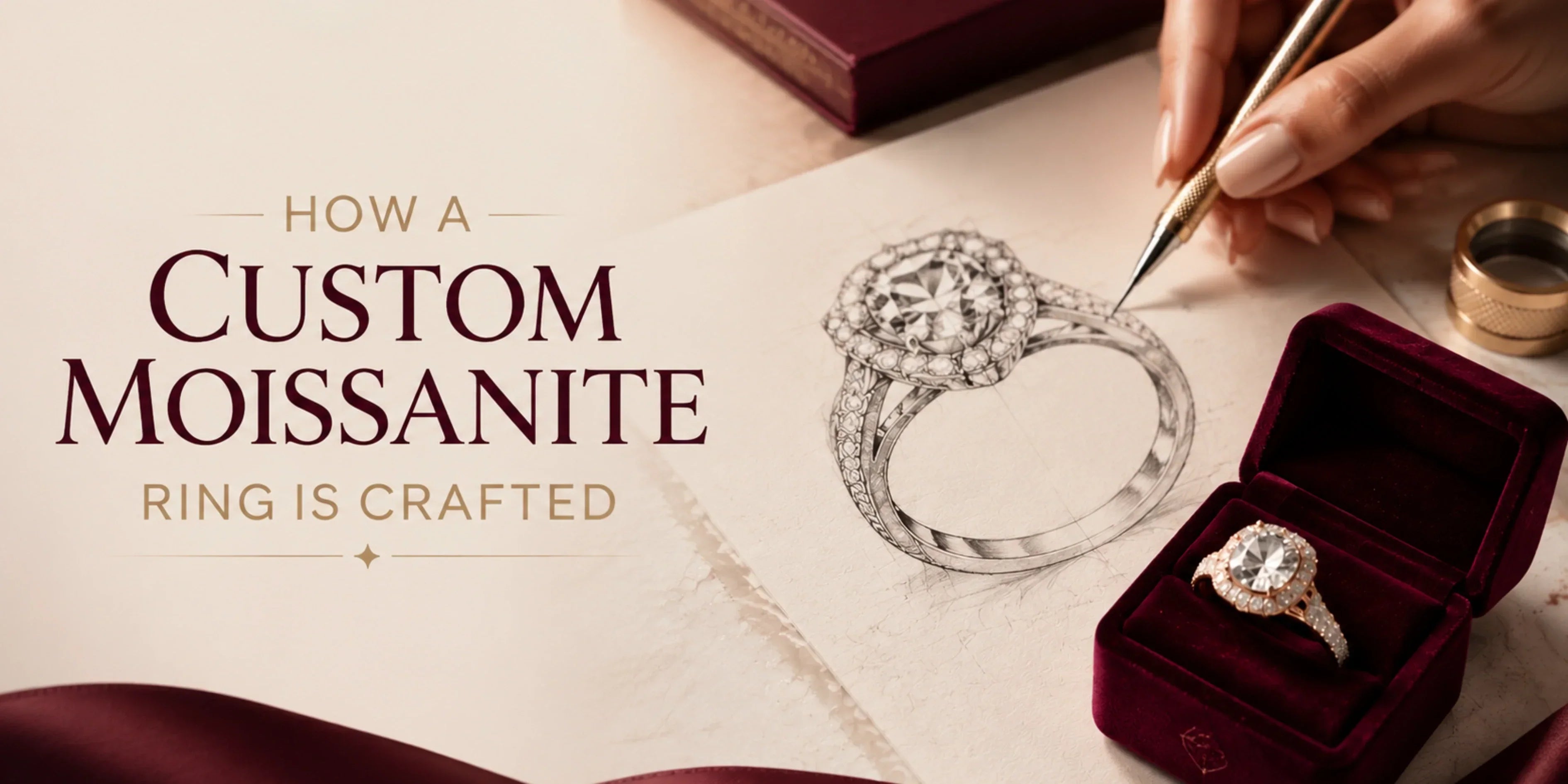
Every custom piece starts with your reference, a sketch, a saved photo, an heirloom stone, or simply a description of what you're picturing. A design consultation follows, where a jeweler works with you to confirm stone shape, setting style, and metal before anything is drawn digitally.
CAD
Your idea is modeled in 3D, giving you a precise, to-scale preview of the ring before a single gram of metal is cast. This is where proportions, prong placement, and band thickness get refined, and it's the stage you review and approve before production begins.
Crafting
Once the CAD file is approved, it's used to build the ring itself. The design is cast in your chosen metal, the moissanite is hand-set stone by stone, and every join, prong, and edge is refined at the bench.
Final Jewelry
The finished ring goes through a quality check, a polishing pass, and a plating step before it's packaged and shipped, typically within 2–3 weeks of your CAD approval.
What Actually Happens at the Bench
Turning a CAD File Into Metal
The CAD file doesn't go straight to a jeweler's bench, it's first used to print a resin or wax pattern of the ring at true scale. That pattern is invested in plaster, and the mold is heated until the pattern burns out completely, leaving a cavity in the exact shape of your design. Molten metal, whether 14K gold or sterling silver, is cast into that cavity, and once it cools, the mold is broken away to reveal a rough version of your ring ready for finishing.
Selecting and Certifying the Stone
While the metal is being cast, the moissanite itself is graded and matched to your design. Most Moiss Era pieces use D–VVS clarity stones, and each one is inspected and paired with a GRA certificate confirming its authenticity before it's set. For custom pieces, stone shape (round, princess, pear, heart, cushion, emerald, oval, radiant, or marquise) and carat weight are locked in during the CAD stage, so the setting is built around the stone's exact proportions rather than the other way around.
Setting, Polishing, and Finishing
Setting is done by hand under magnification. Prongs are shaped and tightened around the stone, pavé work is set one small stone at a time, and bezels are burnished flush against the gem. Once every stone is secure, the ring is polished to remove tool marks and, depending on the metal, finished with a plating pass for its final color and shine.
Final Quality Check
Before a custom piece ships, it's checked against the approved CAD file for accuracy, the setting is tested for stone security, and the ring is cleaned and inspected one more time. Every custom piece is backed by the same lifetime warranty and 30-day return window applied to the ready-to-ship collection.
Custom vs. Ready-to-Ship: What Actually Changes
| Aspect | Ready-to-Ship | Custom Build |
|---|---|---|
| Design | Fixed, chosen from the existing catalog | Built around your sketch, photo, or idea |
| Timeline | Ships in standard processing time | Typically 2–3 weeks from CAD approval |
| Stone Shape | Limited to the listed option | Any of the nine available cuts |
| Approval Step | None, arrives as shown | You review and approve the CAD before crafting starts |
| Price | Fixed listed price | Based on your design, metal, gemstone, and craftsmanship, quoted upfront |
What to Have Ready Before You Start
A reference
A sketch, saved photo, or even a rough description of what you're picturing gives the design team a starting point to work from.
Stone shape and size
Round, oval, cushion, and pear are the most requested cuts, but any of the nine available shapes can be built around.
Metal preference
14K gold plated 925 sterling silver, in white, yellow, or rose tones, shapes both the look and the final quote.
Ring size
If it's for someone else, a sized reference ring or a close estimate keeps the process on schedule.
Budget range
Sharing a rough budget upfront helps shape design options before CAD work begins, rather than after.
Have an idea in mind? Start Your Custom Ring →
Conclusion
A custom moissanite ring takes longer than picking one off a shelf, but the process exists to remove guesswork, not add it. Every stage, from sketch to CAD to casting to the final polish, gives you a checkpoint to confirm the design before it becomes permanent.
Explore the full Moiss Era custom design experience and see whether starting from an existing design or building one from scratch is the better fit for you.
FAQs
How long does a custom moissanite ring take to make?
Usually 2–3 weeks from CAD approval, depending on design complexity. You'll get updates throughout the build rather than a single delivery date and silence in between.
Will I see the ring before it's made?
Yes. A 3D CAD rendering is prepared and must be approved before crafting begins, so there are no surprises once the metal is cast.
Do I need my own sketch or design to start?
No. A saved photo, a stone shape you like, or even a general description is enough for the design team to work from during the initial consultation.
Is the moissanite in a custom piece still certified?
Yes. Custom builds use the same D–VVS clarity, GRA-certified stones used across the ready-to-ship collection, with the shape and carat weight locked in during the CAD stage.
How is pricing determined for a custom ring?
Price depends on your chosen design, metal, gemstone, and the craftsmanship involved. A clear quote is provided before production starts, so there's no guessing at checkout.